
An effective office indoor air-quality program measures conditions that can guide action, not just values that look impressive on a dashboard. Carbon dioxide, fine particles, temperature, and relative humidity are common starting points. The correct sensor set depends on occupancy, outdoor pollution, building materials, activities, ventilation, and known hazards.
Monitoring does not clean the air by itself. Its purpose is to reveal patterns, verify whether controls are working, and help facility teams decide when to inspect ventilation, filtration, moisture, occupancy, or pollutant sources.
Which indoor air-quality parameters matter most?
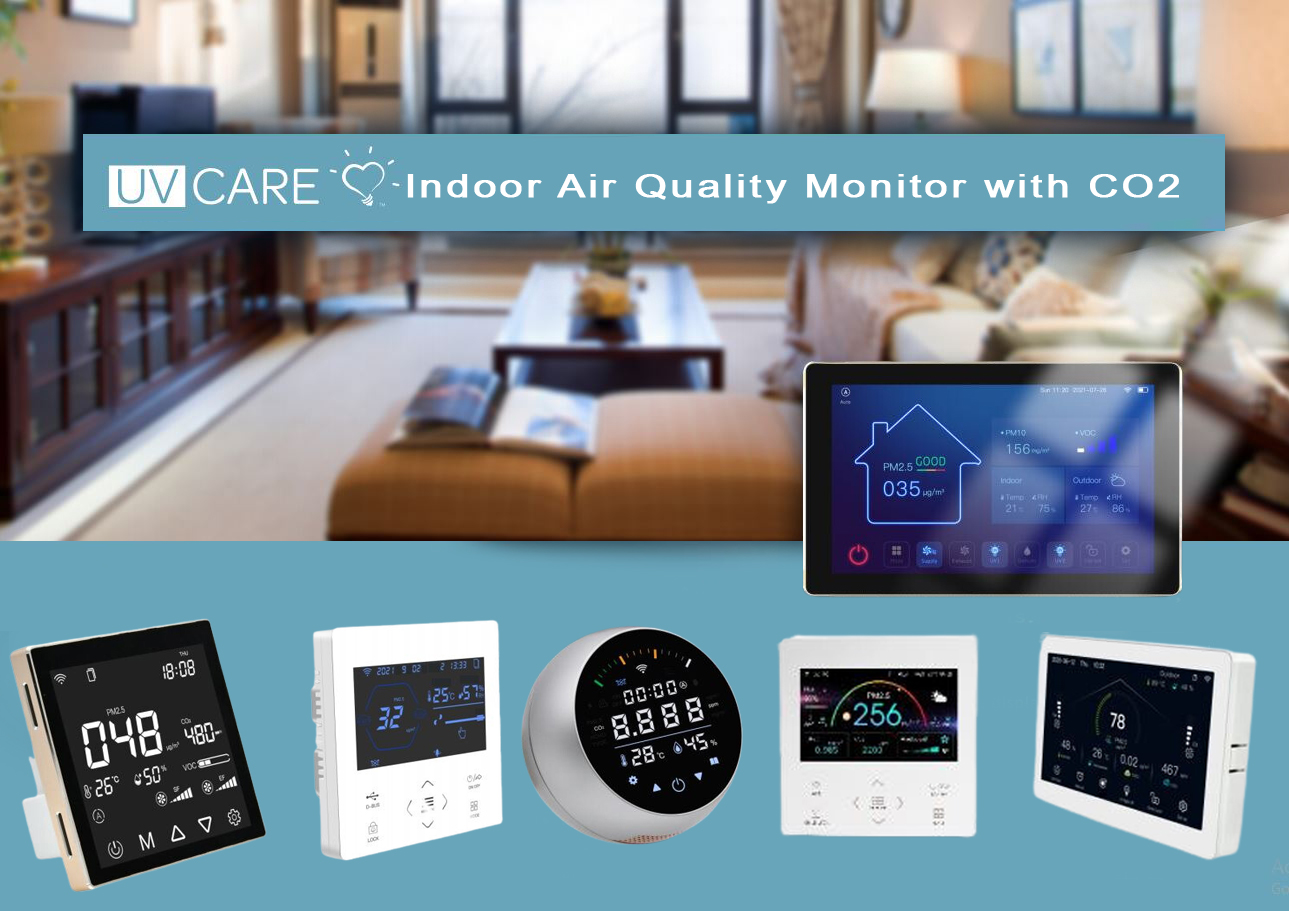
There is no single “IAQ score” that represents every pollutant. A monitor may combine several sensor readings into one colored indicator, but facility managers should retain access to the underlying values. Intech’s indoor air quality monitor with CO2 provides a relevant starting point when planning a building monitoring system.
Common parameters include:
| Parameter | What it can indicate | Important limitation |
|---|---|---|
| Carbon dioxide | Occupancy-related ventilation pattern | Does not measure every pollutant |
| PM2.5 | Fine airborne particle concentration | Low-cost sensors need quality checks |
| Temperature | Thermal condition and HVAC operation | Comfort also depends on air speed and clothing |
| Relative humidity | Moisture conditions and condensation risk | Varies with temperature and sensor location |
| Total VOC estimate | Changes in mixed volatile compounds | Often not compound-specific |
| Carbon monoxide | Combustion hazard | Requires an appropriate safety-rated detector |
Specialized sites may need formal sampling for specific chemicals, biological agents, pressure relationships, or ventilation rates. Consumer-grade sensors are not substitutes for occupational exposure assessments.
What does office CO2 tell you?
People exhale carbon dioxide, so indoor CO2 commonly rises when occupied spaces receive insufficient outdoor air relative to the number of occupants. A trend that increases during meetings and falls after the room empties can reveal ventilation and scheduling patterns.
CO2 is best treated as a ventilation indicator, not a universal measure of air cleanliness or infection risk. A low reading does not prove that particles, gases, mold, or outdoor pollution are controlled. A high reading should trigger investigation of occupancy, ventilation schedules, damper positions, airflow, sensor accuracy, and room use.
Outdoor CO2 varies, and indoor targets should be interpreted in context. Facility teams should avoid presenting one threshold as a complete pass-or-fail test without considering applicable standards and the building design.
Where should sensors be installed?
Install sensors in the occupied zone where readings represent what people breathe. Avoid direct placement beside supply diffusers, open windows, exterior doors, printers, pantry appliances, direct sunlight, or a person’s face. Those locations can create readings that are locally high or low but not representative.
Meeting rooms, training rooms, densely occupied departments, reception areas, and spaces with previous complaints are strong priorities. One monitor may be insufficient for a large floor with several air-handling zones.
Document the mounting height, room served, sensor serial number, calibration or verification date, and nearby influences. Consistency makes trend comparisons more reliable.
How often should readings be collected?
Continuous monitoring reveals peaks and daily patterns that occasional spot checks miss. Use intervals appropriate to the sensor and building, then compare data with occupancy schedules, HVAC operating hours, cleaning, renovation, deliveries, and outdoor conditions.
A useful dashboard should show current values, time trends, alerts, missing data, and sensor status. Retain raw or exportable data when possible. An attractive gauge without historical records makes root-cause analysis difficult.
Review periods should include normal workdays, peak occupancy, weekends, and unusual events. If a complaint occurs at 3 p.m., an average for the entire day may conceal the relevant peak.
How should alerts be designed?
Set alerts that lead to a defined response. Too many alarms create fatigue; thresholds that are too broad may miss developing problems. Use staged notifications where practical.
For example, a sustained CO2 increase might prompt staff to verify room occupancy and ventilation operation. A humidity alert could trigger inspection of condensate drains, leaks, infiltration, or cooling performance. A PM2.5 spike might be compared with outdoor conditions, cooking, cleaning, printing, or nearby construction.
Every alert procedure should name the responsible role, response time, inspection steps, documentation method, and escalation path.
How do you verify monitor accuracy?
Select sensors with published ranges, accuracy statements, maintenance instructions, and calibration or field-verification options. Confirm whether specifications apply across the building’s expected temperature and humidity.
Co-locate sensors periodically to identify units that drift apart. Compare selected devices with a reference instrument maintained by a qualified provider. Replace sensors or modules at the end of their stated service life.
Automatic baseline correction can be useful in some buildings but problematic in spaces that never return to an assumed outdoor baseline. Understand the sensor algorithm before enabling it.
How does monitoring support an IAQ plan?
Start with a building survey, complaint history, HVAC documentation, occupancy patterns, and source inventory. Use monitoring to test specific questions. For example: Does the training room receive enough ventilation at full capacity? Does humidity rise overnight? Do particle levels follow outdoor traffic peaks?
Then connect findings to controls: source removal, schedule changes, local exhaust, outdoor-air adjustment, filtration, pressure correction, moisture repair, or equipment maintenance. Depending on the findings, teams may evaluate commercial air purifiers or a Zero Carbon ERV system. Verify the result with follow-up data.
Frequently asked questions
Is CO2 itself dangerous at normal office levels?
Typical office monitoring focuses on CO2 as an occupancy and ventilation indicator. Occupational exposure limits address much higher concentrations. Interpret readings with applicable standards and professional advice.
Can one IAQ monitor cover an entire office?
Usually not if the office contains multiple rooms, HVAC zones, occupancy densities, or pollutant sources. Use representative sensors based on a site plan.
Does an air purifier lower CO2?
Ordinary particle and activated-carbon filters do not meaningfully remove occupant-generated CO2. Outdoor-air ventilation is normally required.
What should we do when PM2.5 rises outdoors?
Review outdoor-air intake, filtration, pressure, infiltration, and operational guidance. Do not close ventilation blindly if it creates other indoor-air problems.
How long should IAQ records be kept?
Retain enough history to compare seasons, complaints, maintenance, and upgrades. The exact period should match company policy, risk, and regulatory requirements.
Need help planning a monitoring strategy? Contact Intech Philippines for a site assessment.