
An electrostatic precipitator (ESP) for a commercial kitchen should be selected from the actual exhaust duty, contaminant load, duct arrangement, and operating schedule. Choosing a unit only by a nominal airflow number can leave a restaurant with visible discharge, excessive pressure loss, difficult cleaning, or equipment that operates outside its intended range.
The correct design treats the ESP as one part of a complete kitchen-exhaust system. Hoods, grease filters, ductwork, access doors, fans, odor-control stages, discharge location, make-up air, controls, and maintenance procedures all affect the result.
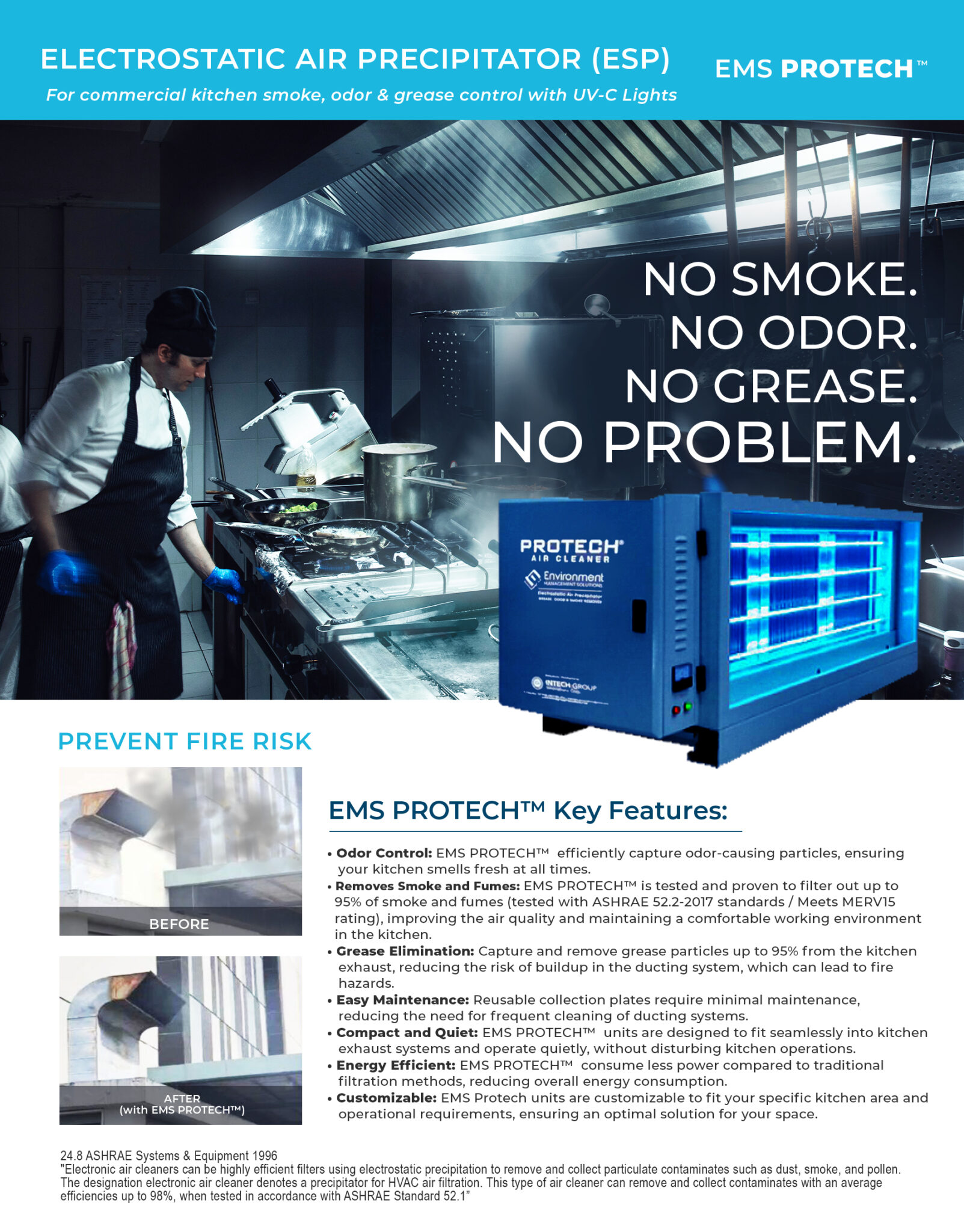
What information is needed before sizing a kitchen ESP?
Begin with the design exhaust airflow for every hood connected to the treatment system. Confirm whether the value is measured, calculated, or taken from a drawing. Record the hood type, duct dimensions, fan duty, available electrical supply, operating hours, and the space available for equipment and service access.
The food concept matters. Light reheating does not create the same aerosol loading as high-temperature frying, charbroiling, wok cooking, or solid-fuel cooking. Menu changes and peak-hour production should be considered because an ESP must handle the demanding periods, not only the average day.
- Design and measured exhaust airflow
- Cooking appliances, fuel, menu, and production rate
- Existing grease filtration and hood condition
- Duct route, fan curve, and available static pressure
- Discharge point and nearby sensitive receptors
- Daily operating hours and cleaning resources
- Space for access doors, wash area, and safe servicing
Why must airflow be verified?
Air velocity through the ionizing and collecting sections affects particle charging, capture, and pressure loss. If actual airflow is higher than the selected unit can properly treat, smoke may pass through before particles are collected. If airflow is much lower than expected, the overall exhaust system may not capture contaminants at the hood.
Field measurements are especially important in retrofit projects. Duct leakage, dirty filters, fan modifications, closed dampers, and unrecorded branches can make actual conditions different from old drawings. A qualified team should reconcile the hood requirement, fan performance, and treatment equipment before final selection.
How does cooking load change the selection?
Grease and smoke concentration determine how quickly collecting cells become contaminated. Heavy-duty cooking may require multiple treatment stages, additional capacity, more frequent washing, or an automated cleaning arrangement. The objective is stable performance across the cleaning cycle, not only immediately after a cell is washed.
Particle control and odor control are separate engineering tasks. An ESP primarily targets airborne particulate and oily aerosol. Depending on the process and neighbors, the system may also need an appropriate odor-control stage after particle removal. Removing grease first can help protect downstream media and extend useful service intervals.
What pressure-loss information is required?
Every component adds resistance: hood filters, ESP sections, odor-control modules, silencers, transitions, elbows, duct length, and the discharge fitting. The exhaust fan must deliver the required airflow against the total system pressure. A fan selected without the final treatment train may underperform after the ESP is installed.
Use manufacturer data at the intended airflow and contamination condition. Allow for normal loading between cleaning cycles. Transitions should be gradual, and airflow should be distributed evenly across the ESP face. Poor entry geometry can overload one section while leaving another underused.
Should one large ESP or several modules be used?
The answer depends on redundancy, space, access, zoning, and operating pattern. Modular arrangements can match separate kitchen zones or provide service flexibility, while a centralized unit may simplify a shared exhaust path. The design should prevent untreated bypass and make it possible to isolate equipment safely for maintenance.
Consider how cells will be removed, transported, washed, dried, and reinstalled. A compact equipment room is not useful if technicians cannot open doors fully or handle components safely. Maintenance access should be shown on coordinated drawings before construction.
How should controls and safety be coordinated?
The ESP should operate only when the associated exhaust fan is proven to run and airflow conditions are acceptable. Controls may include fan interlocks, high-voltage status, fault indication, wash-cycle logic, and alarms. Requirements differ by model and project, so the approved manufacturer sequence must govern.
Fire-safety provisions, grease-duct requirements, access, clearances, and electrical isolation must follow applicable codes and the project’s authority requirements. An ESP does not replace compliant hoods, grease filters, duct construction, fire suppression, or routine duct cleaning.
What should be included in the equipment schedule?
| Schedule item | Why it matters |
|---|---|
| Design airflow | Matches treatment capacity to the verified exhaust duty |
| Cooking classification | Describes expected grease and smoke loading |
| Number of stages | Defines the intended particle-removal arrangement |
| Pressure loss | Supports fan and system calculations |
| Electrical data | Supports power, controls, and isolation planning |
| Access clearance | Enables cell removal and safe servicing |
| Cleaning method | Aligns the design with site maintenance capability |
Frequently asked questions
Can an ESP be added to an existing kitchen exhaust?
Yes, when a site survey confirms airflow, fan capacity, duct condition, space, power, discharge constraints, and maintenance access. Retrofitting without these checks can transfer the problem elsewhere in the system.
Does a larger ESP always perform better?
No. The equipment must operate within its approved airflow range and be integrated correctly. Oversizing does not correct poor hood capture, uneven airflow, damaged cells, or inadequate maintenance.
Will an ESP remove all cooking odor?
Not necessarily. Particle capture can reduce smoke and grease aerosol, but gaseous odor may require a separate, properly selected downstream control stage.
How often should cells be cleaned?
The interval depends on cooking load, operating hours, pre-filtration, and the manufacturer’s instructions. Performance trends and inspections should be used to refine the schedule.
Explore Intech’s electrostatic air precipitator solutions and EMS Protech Smart Auto-Clean Pro ESP system. For equipment selection and system coordination, contact Intech Philippines.