
An electrostatic precipitator, or ESP, removes grease and smoke particles from kitchen exhaust by electrically charging them and collecting them on oppositely charged plates. It can reduce visible emissions and downstream grease loading, but it does not replace capture hoods, grease filters, duct cleaning, fire protection, odor treatment, or compliant exhaust discharge.
Successful performance depends on the complete kitchen-exhaust system. An ESP selected without verified airflow, cooking load, duct conditions, and maintenance access can underperform even when the equipment itself is sound.
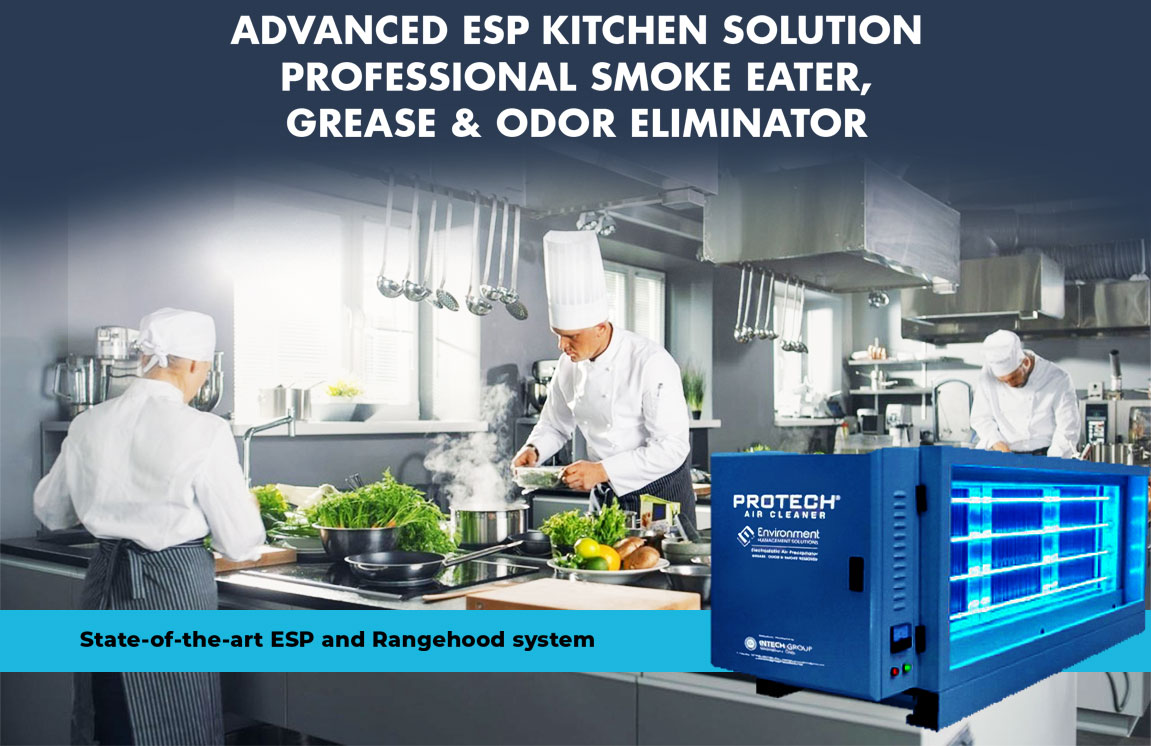
What contaminants come from commercial cooking?
Cooking produces heat, water vapor, grease aerosols, smoke particles, odors, and gases. The quantity and particle size depend on the appliance, fuel, food, temperature, oil, cooking method, and production rate.
Charbroiling and wok cooking can produce different emissions from light baking. A system designed for a low-volume cafe may not suit a high-output restaurant using solid fuel or heavy frying.
Kitchen exhaust design begins at the hood. Capture and containment must prevent the plume from escaping into the occupied kitchen. The exhaust then passes through listed grease-removal devices and other treatment stages before discharge.
How does an ESP collect particles?
An ionizing section applies a high voltage that gives airborne particles an electrical charge. The charged particles then move toward collector plates and adhere to them. Cleaned air continues downstream.
Collection efficiency varies with particle properties, airflow velocity, residence time, electrical field, plate cleanliness, and equipment condition. Grease accumulation can reduce performance and create operational or fire concerns, making regular wash cycles and inspection essential.
An auto-clean system can simplify plate washing but does not eliminate maintenance. Detergent supply, wash nozzles, drains, sumps, insulators, electrical components, and access doors still require inspection.
What can an ESP remove, and what remains?
| Exhaust component | ESP effect | Additional control often needed |
|---|---|---|
| Grease aerosol | Can collect a substantial portion | Hood filters and duct cleaning |
| Fine smoke particles | Can reduce visible emissions | Correct staging and maintenance |
| Odor gases | Limited particle-only effect | Activated carbon, oxidation, or other odor control |
| Heat | Does not remove it | Exhaust and make-up air design |
| Water vapor | Not its primary function | Ventilation and condensation management |
| Combustion gases | Does not provide general gas control | Appliance, ventilation, and code compliance |
An ESP may reduce odor associated with captured particles, but gaseous odor molecules can pass through. Projects with sensitive neighbors often need a dedicated odor-control stage.
How is the correct ESP capacity selected?
Determine the actual design airflow for every hood and operating mode. The ESP face velocity and internal residence time must remain within the manufacturer’s range. Do not size solely by duct diameter or restaurant floor area.
Review the cooking-duty classification, hours of operation, expected particulate load, exhaust temperature, humidity, detergent compatibility, available electrical supply, drainage, service clearances, and discharge route. Include pressure drop in the fan selection.
If several hoods share a system, evaluate simultaneous operation and balancing. Variable-air-volume systems require controls that keep the ESP within its acceptable airflow range.
Where should an ESP be installed?
Locate the unit where ducts can approach and leave it with suitable transitions and where technicians can safely open access doors, remove components, and service the high-voltage section. Provide drainage for wash water and contain any leakage.
The installation must comply with fire, mechanical, electrical, environmental, and local building requirements. Fire suppression and grease-duct provisions should be coordinated with the authority having jurisdiction.
Outdoor installations need weather protection and corrosion consideration. Indoor installations may require a dedicated service area, leak protection, ventilation, and safe electrical isolation.
What maintenance does an ESP require?
Maintenance frequency depends on cooking load and operating hours. A high-volume kitchen may require more frequent washing than the default calendar interval. Build the schedule from inspection evidence.
Typical tasks include:
- Inspecting pre-filters and collector cells
- Verifying wash cycles and detergent concentration
- Cleaning ionizers, plates, and insulators
- Checking high-voltage components and safety interlocks
- Clearing drains, sumps, and spray nozzles
- Inspecting seals and access doors
- Recording pressure, current, alarms, and visible discharge
- Coordinating duct and hood cleaning
Only trained personnel should service high-voltage equipment. Follow lockout, discharge, and verification procedures in the manufacturer’s manual.
How can performance be verified?
Commission the system at design airflow. Verify hood capture, duct balance, fan operation, pressure drop, electrical readings, wash cycle, drainage, and controls. Observe the discharge under representative cooking production, not only when the kitchen is idle.
Trend alarms and maintenance records. A gradual increase in visible smoke or odor may reflect dirty cells, failed power supplies, airflow changes, increased cooking load, or an exhausted downstream odor medium.
Frequently asked questions
Does an ESP remove cooking odors?
It primarily captures particles. A separate odor-control stage is often necessary for gaseous cooking odors.
Can an ESP prevent grease-duct cleaning?
No. It can reduce downstream loading but does not eliminate grease accumulation or legally required inspection and cleaning.
Is auto-clean maintenance-free?
No. Auto-clean systems still need detergent, water, drainage, nozzle, cell, electrical, and control maintenance.
Can an ESP be added to an existing kitchen?
Often, but engineers must verify airflow, fan capacity, space, structure, drainage, electrical supply, access, fire requirements, and discharge conditions.
What causes an ESP to arc?
Possible causes include contamination, moisture, damaged components, incorrect spacing, or foreign material. Trained technicians should diagnose recurring arcing.
Review Intech’s electrostatic air precipitator solutions and the EMS Protech Smart Auto-Clean Pro ESP system, or discuss your kitchen-exhaust project.